Scotland

This particular blog series chronicles our 11 day family trip to Scotland in the Summer of 2011. Each of our children has been told that they may have an international trip as a high school graduation present to broaden their horizons and deepen their interests. Provided the country they pick is not on the list of places the State Departmet feels Americans should avoid, they can pick just about anywhere that interests them. Our oldest son Will, true to his Scottish heritage, and his interest in all things Scottish chose to visit the "motherland." While this blog is not from his perspective, it is written with an eye towards "traveling as a family," observations about culture and history, as well as simply chronically our experiences as they happen and as I interpret them.

Wednesday, November 19, 2014

Goodbye For Now


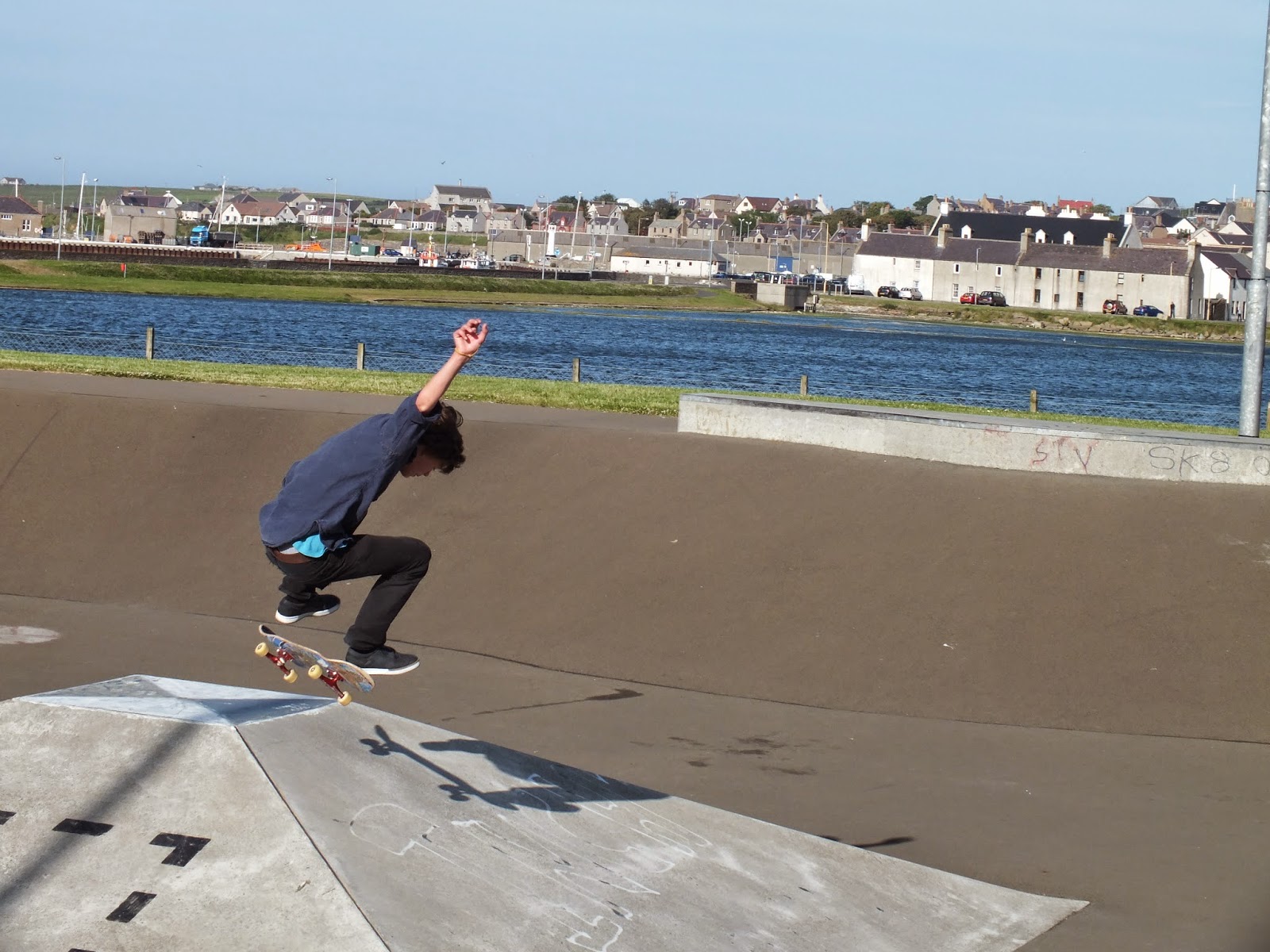
Orkney Skate Park, Kirkwall

Leaving Broch of Gurness we turn south on the main road toward Kirkwall to find a skateboarding park and a dinner location, hopefully one that serves local seafood.  The roads here are very narrow. Many of the main roads are one lane with turn outs to allow cars to navigate past one another.   Drivers must cooperate with one another here and I begin to wonder if the USA could benefit from less highway projects to add lanes and more opportunities for driver cooperation.  (Not!) We are so accustomed to getting to point B from point A quickly.  I've noticed that we are always on the go when in the car here albeit  slowly and rarely do I see stop signs or red lights, we only yield when we go through a roundabout.  Perhaps it  is all the stop lights that frustrate American drivers and leads to so much road rage.  I like the pace here but then again I am on vacation.


Kirkwall comes into view thankfully, Sam and I are tired.  I realize that if I were driving the car I would be making mistakes by now because I am confusing which side of the road we are supposed to be driving on.  We are looking for a skateboard park for Thomas that we know is in Kirkwall.  When we find it near the Tesco, we park the car and Thomas gleefully speeds toward the park, Will following with the camera.  Sam and I lay the seats back in the car and take a short cat nap.  Thomas will be able to tell his friends he has skateboarded on Orkney and will even be able to post pictures on Facebook.


Orkney Skate Park, Kirkwall

Rested, we find the Kirkwall Hotel with the restaurant on the harbor and order the usual hearty Scottish fare- steak pie with puff pastry and fresh salmon which I never tire of.  The restaurant is very comfortable and well appointed and it feels nice to sit and relax after our windswept day. Suddenly, we realize it is the 4th of July but there has been no fanfare here to let us know what day it is.  For a moment I miss home and all things USA, but only for a moment, we have had one of the most memorable days.  We drink a toast to the good ole US of A.

Kirkwall Hotel, Orkney Island, Scotland  http://www.kirkwallhotel.com/index.html


Arriving back at our lodging at Houton Bay we have a wee bedtime dram of Scotch at the bar and meet one of the locals.  Our hostess explains to us that his last name is "Grote" and he is said to be one of the descendants of the namesake "John O'Groat which is the northernmost town on the Scottish mainland.  Land's End, the southern most tip of the UK, is at the other end and tourist pride themselves in visiting both while in the British Isles.

http://en.wikipedia.org/wiki/John_o'_Groats

We chat about this as well as our the other adventures of the day. Realizing we are leaving tomorrow,  I am a bit sad.  I don't want to be leaving just yet!  Didn't I just get here?  If I had more money and time I would travel slowly, grazing my way through the region taking my time to get to know some of the local folks, breathing deeply of the landscape and the culture.  This is goodbye, for now,  I will be back.  We retire to our room to rest and pack, our ferry leaves at 11:00 tomorrow morning and we have a long drive ahead of us to Isle of Skye.
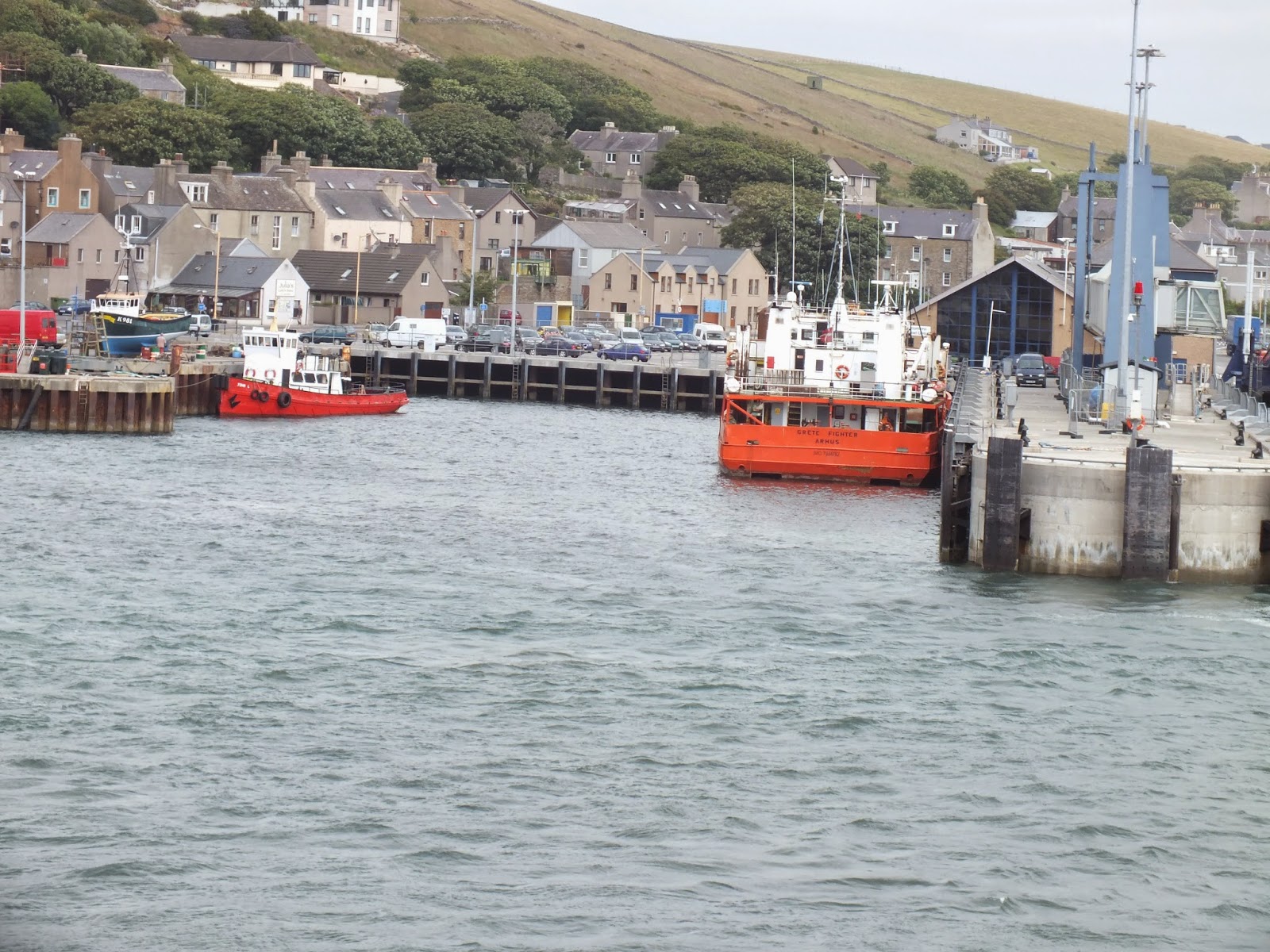
Harbor Stromness, Orkney Island, Scotland


Wednesday, November 5, 2014

Broughs and Brochs


Brough of Birsay, Orkney (low tide)
Maeshowe had been a nice respite from the wind and now we are ready to head up to the northwest tip of  the island to explore the Brough of Birsay, a small island only accessible during low tide.  We have timed our adventure just right.  The sun has finally come out making the wind more tolerable. My vantage point from the car allows me to regard the effects of the wind without my hair whipping into my eyes.  Orkney is largely agricultural and the grain crops undulate in the fields fiercely like there is a small army underneath charging toward the end of the fields  Forming a large moving patchwork blanket, the fields seems almost like a single living creature if you stand still, unfocus your eyes and stare at the horizon long enough.

Path to Brough of Birsay, Orkney

Finding the Brough of Birsay, we trek across the concrete path toward the island. Thought to have been first settled by Christian missionaries in the fifth century AD, the island  became a Pictish stronghold in the 9th century before being completely taken over by the Vikings.  The sight itself is archelogically rich for this reason.  Although the Norsemen built their dwellings on top of  and around what remained of Pictish foundations, the artifacts found show that the  Picts had operated a small forge on the island.  The most important find occured in 1935 with the discovery of the Pictish Symbol Stone, the original which now resides in a museum in Edinburgh.

Viking and Pictish ruins, Brough of Birsay, Orkney
http://www.orkneyjar.com/history/broughofbirsay/

The island itself resembles a large bowl that has been upended.  There are  cliffs of varying sizes, and a lighthouse at the top of the island.  There are no trees and the grass on the island is almost knee level and the tips are an aubergine color.  The frequent wind has tangled the tips of the grasses together into different shapes and patterns that are interesting.

Sea birds and cliffs, Brough of Birsay, Orkney


Cliffs, Brough of Birsay, Orkney


After exploring the ruins we set off up the hill an find the cliffs on the northern side of the island.  Not wanting to watch my children peer over the edge of the cliff, I tell my family that I am going to the top of the hill.  Cresting the hill I linger and enjoy the view near the lighthouse.  Small caves  and other depressions no doubt created by wind and water permeate this side of the island and I explore some of these depressions before making my way down the south side of the island.  I must have taken a long time to do all this.  At one time I wait for Sam and the boys to catch up with me but they never came.  When I finally head back to the ruins I see  my oldest son Will charging up the middle of the hill toward the lighthouse.  Waving at him he sees me and throws up his hands in a relief gesture.  Apparently, Sam and the boys had walked back to the parking lot, even driven to a nearby castle ruin looking for me.  They had really been worried that I had fallen or something.  Regrouping, we make a pact to not separate from one another again as I have the only working cell phone of the four of us.


Brough of  Birsay cliffs, Orkney
Relieved, we head to the car to visit our last site, Broch of Gurness, over on the east side of the island.  Driving through the bald undulating landscape with the windows cracked we experience the smells of crops, barnyard, and fresh windwhipped air.  We pass a small loch (Loch Swannay) that is the darkest inkiest shade of blue, the contrast against the lanscape is stunning.  Water whether it be in a loch, bay, river, ocean or even a small puddle is capable of registering so many different shades of blue, green, gray and even pink, orange and white.  I drift off on a tangent thinking of the miraculous properties of water when we turn into the car park for Broch of Gurness.

Arriving at Broch of Gurness, we are informed that the site is closed.  My search and rescue had taken up a fair amount of time.  The kindly Orcadian gentleman operating the site allows us to go ahead and have a look around anyway.  All around Scotland we have witnessed this sort of kindness.  We thank him and have a quick survey.  Broch of Gurness  is situated on Eynhallow Sound with views of other islands to the north.  A "broch" is a uniquely Scottish structure, round and of dry stone construction.  There are many examples of brochs throughout Scotland in various stages of decay and/or preservation.  It is thought they may have served a military purpose much like a castle tower or they could have simply been dwellings.  The brochs here are thought to have been built between 200-100 BC.  As with other ancient sites on Orkney it to has the Pictish/Viking past.   The story of the rediscovery of this site is interesting (see link below.)

http://www.orkneyjar.com/history/brochs/gurness/

Broch of Gurness, Orkney
Walking to the car I realize what a glorious day it has been even with all the drama on Brough of Birsay.  We will head towards Kirkwall to relax and find some dinner.

Limpets, Brough of Birsay, Orkney


Thursday, October 23, 2014

Maeshowe and Viking Graffiti


Leaving Skara Brae we do a much better job of navigating our way to Maeshowe.  Nearing our destination, we navigate a strip of land between Loch Harray and Loch Stenness which contains two significant neolithic henges, The Ring of Brodgar and The Standing Stones of Stenness.  On the left we see the Ring of Brodgar, thought to date from 2500 to 2000 BC and containing 27 stones each measuring between 7 and 15 feet in height.

The Ring of Brodgar, Orkney, Scotland
 About a mile down the road on our left we see The Standing Stones of Stenness having fewer stones but much larger ones standing up to 19 feet high.  This henge sight is thought to date from 3100 BC.   All of the sights we are seeing today are UNESCO World Heritage Sites.

http://whc.unesco.org/en/list/514

http://www.orkneyjar.com/history/brodgar/index.html

http://www.orkneyjar.com/history/standingstones/

Standing Stones of Stenness, Orkney, Scotland

We arrive at Maeshowe, an impressive neolithic burial chamber, one of the best preserved in Europe.  The site stages small group tours at an old mill converted to a gift shop across the road where we wait our turn.  Resembling no more than a large hillock from the path, it would be easy to overlook.


http://www.orkneyjar.com/history/maeshowe/chamber.htm


Path to Maeshowe, Orkney, Scotland

Entrance to Maeshowe, Orkney, Scotland

Access to the cairn is through a long low passageway and then the space opens up into a large chamber made up of many slabs of immense stone.  We were not allowed to take pictures inside but I found a picture of a postcard on the internet that shows the impressive interior.
Interior and main passageway Maeshowe, Orkney, Scotland


The only artifacts that were ever found at Maeshowe were some human skull fragments and horse bones according to our tour guide.  Norsemen sought shelter here during the 11th and 12th century and they no doubt cleared the tomb of it's contents.  One things for certain, they left behind a lot of graffiti on the carefully placed stones, in fact, this sight has one of the largest and most impressive collections of Runic inscriptions in Europe.  If you can read the Runic alphabet, you have no problem reading the inscriptions, but since none of us are experts in 12th century Nordic languages she gives us a hand with some of the translations.  They basically say things like -- "Thor was here" and "Thor is the best!"  Some of the inscriptions refer to women and are downright bawdy, much like something you would find on a bathroom wall.  Some things don't change much even after 1000 years.....  More information about the Viking graffiti is provideded in the link below.

http://www.orkneyjar.com/history/maeshowe/maeshrunes.htm


Monday, October 20, 2014

Urquhart Castle


Shoreline Firth of Moray


We had a lovely if not brief stay in Nairn.  The weather has cooperated and we have had sunshine and mild temperatures.  Hubby enjoyed his game of golf at The Nairn Golf Club and we explored the Moray Firth.  http://www.nairngolfclub.co.uk/

Teeing off at The Nairn Golf Club

"sea bacon" Moray Firth
We pack up the car and head toward Inverness on A9.  It is sizing up to be a "crackin" day.  The heather is beginning to bloom and the sheep in the fields sport their summer haircuts.  For whatever reason I get the feeling we are headed up to the lid of the world as everything feels spread out and flatter even with the mountains in the distance.  My hubby negotiates the roundabouts and I have become expert at navigating him through them saying "1/3, 1/2 or 3/4" the way around to indicate where we need to exit.  We have several roundabouts in Inverness to negotiate on our way to Loch Ness and Urquhart Castle. We head into a mountainous area on the other side of Inverness as we approach Loch Ness.  Mountain meadows, cottages, fresh air, hikers, bikers, sunshine what more could anyone want on a day like this. 

Urquhart castle was an enormous castle ruin, much larger than what I had expected.  The visitors center had a comfortable cafĂ© and shop with an interpretive center and a short film reviewing the Castle's history.  We avail ourselves of all three before going down to explore the ruins. 
http://www.urquhart-castle.co.uk/

Urquhart Castle

Loch Ness

We meet a young man dressed in a kilt at the base of the castle who works for the park service dressed in a weathered Buchanan kilt.  He tells us his mother's surname is Buchanan and then explains to us that there is a Buchanan castle near Loch Lomond, it is a ruin with no roof or windows.  Apparently, those were removed in the 1950s to avoid paying property taxes.    No, roof, no windows = no taxes hence many grand structures have been reduced to a pile of rubble due to this unfortunate tax edict.  Strangely, no Buchanan's ever lived there.  The Duke of Montrose built the castle in 1954 where the family lived until the early 1900s when it was sold to the Graham family.  It then served as a hotel and as a hospital during the war before it reach it's current state. 


I make quick mental notes to do more research on this as we head back to the car.


Nessie doesn't live here anymore


As we head back toward Inverness my youngest son can't resist -- he wants to stop at the exhibit we passed on the way in that features the Loch Ness Monster.  How could I blame him, he's been fascinated with Sasquatch since his days camping with the Cub Scouts and being scared witless with stories of such creatures around the campfire.  We were going to avoid it, thinking we were all far to sophisticated for such a thing.  His curiosity gets the better of him and we pull into the car park and pay the admittance fee and walk through the exhibit which features various small theaters with video about the legend.

http://www.lochness.com/loch-ness-monster-exhibition.htm

What I thought was going to be a hokey display --very sensationalized and all was actually very informative.  While there might have been some prehistoric creature on the verge of extinction during the time of St. Columba, scientist don't believe there is enough food sources in the Loch to support such a creature.  Loch Ness is not very rich in nutrients.  Sonar and core samples of the bottom of the Loch also have not turned up any evidence.  Examinations of the bottom of the Loch have turned up evidence of other key events -- a great flood in the 1800s, nuclear testing and Chernobyl.  Luckily the Loch has been spared the effects of acid rain.  I quietly applaud the park service for seizing the opportunity to impart an environmental lesson rather than taking the easy route.  They took the high road here. (no pun intended) 

We exit the exhibit and must follow the whole length of the gift shop cram packed with "Nessie"  t-shirts, key chains, stuffed Nessies plus the usual tartan fare to get back to the car park.   There may not be a Nessie in the Loch but she is certainly alive an well in the gift shop.  Still, the impression has been very positive and I am glad we made the stop.

Sunday, October 19, 2014

Prehistoric Orkney--Skara Brae


Today we will visit the prehistoric and Pictish ruins for which Orkney is known for.   Our hostess Lynda at Houton Bay Lodge is a wealth of information.  We drive the 8 miles back into Stromness and right off the bat we get lost.  Never mind that we managed to get out of Edinburgh without getting lost.  We negotiate our way back out of town and finally get back onto the right road headed towards Skara Brae.

www.orkneyjar.com/history/skarabrae/

Skara Brae, situated on the Bay of Skail, is a ruin from the late Neolithic period thought to date from as early as 3200 BC.  In other words, these ruins are around 5,000 years old.  During the winter of 1850 a tremendous storm battered this side of the island and the ruins were exposed.  What initially was thought to be a Pictish ruin turned out to be one of the oldest and best  preserved neolithic villages  in Western Europe.  The site features a visitors center, gift shop and cafe as well as a replica house that can be viewed up close before viewing the actual ruins.  We view the replica and then head outside into the scouring wind to view the ruins which are several feet down in the ground.  We quietly look down into the small group of dwellings where men, women and children carried on their lives 5000 years ago and try to image the sounds of a prehistoric household might make -- the sound of children playing and the tending of daily chores.  Without the benefit of forged metal, using only bone, wood, animal hide and clay the inhabitants of these dwellings attempted to fashion lives for themselves.


Neolithic ruins, Skara Brae, Orkney Islands

We walk down to the beach where we find relief from the howling wind.  I find myself a bit frustrated because no words, no pictures, no vacation trinkets can adequately encapsulate what I am seeing and experiencing in this incredible landscape.  I look down at the pebbles and rocks on the beach remembering what my grandmother always did when visiting a place.  She never went to far flung places - Hot Springs Arkansas, and Florida-- but she brought home a rock or stone from wherever she had been, some of them quite large and many of them ended up forming a border in her flower bed.  Looking down I spot a small flat stone a bit bigger than a quarter with a rust colored background and charcoal grey veins.  I stoop to pick it up, wipe it off and let it dry out a bit before slipping it into my pocket.  The stone is older than the ruins themselves and a reminder that all places are special and millions of years in the making .

We climb back to the visitors center and have a very tasty lunch in the cafe before heading to our next site.

Beach, Bay of Skail

Beach, Bay of Skail

Friday, October 17, 2014

A Ferry Ride to the Orkney Islands


Our ferry is on time and the line of cars and trucks pulls into the belly of the ship and we climb the stairs to the upper levels of the boat. 

MV Hamnavoe which serves Scrabster on Scotlands mainland and Stromness, Orkney Islands.


http://www.northlinkferries.co.uk/on-board/


The MV Hamnavoe has 3-4 levels and is downright luxurious compared to my expectations.   My only other experience with ferries was in North Carolina taking the ferry to Okrakoke Island.  Looking back, that boat was a shrimp trawler compared to this.  It is outrigged with a bar, restaurant, gift shop and even a small electronic casino type area in addition to the massive holding area for cars and even large delivery trucks underneath.  We have a snack in the restaurant and walk up to the bar area, order wine and step out onto the back deck.
Hubby on the back deck of MV Hamnavoe

Enjoying my wine on the back deck of the MV Hamnavoe


The engines chug and chuff away while we look out at the far distant landfalls -- mainland Scotland to the south.  It is possible to view the typical Scottish weather patterns of drier on the east side while the west side shows more gathering clouds.

 Most of the passenger prefer the side of the deck which will have a good view of The Old Man of Hoy as we approach Stromness.  I linger on the west side in the warm Sunshine and ponder how on earth I will ever describe what I am seeing in my travel journal.  It's a rather simple view of sea, sky, clouds and sunset but it feels so vast, deep and wide.  All sunsets are unique and artists have driven themselves to madness trying to paint sunsets.  I simply chose to take a picture and leave it at that.


The Old Man of Hoy comes into view on the right side of the boat, a large chimney shaped rock formation off the Island of Hoy.  I am told that rock climbers routinely clamor to the top.

Old Man of Hoy, Okney Islands


Our ferry docks in Stromness, we fetch our car, pull out and turn right to head to our nights lodging eight miles away at Houghton Bay Lodge in Orphir on the southern tip of the main island.   http://www.houtonbaylodge.com/ It is a short trip and we find our accomodations to be homey, well appointed, comfortable and quiet.  Our hostess Linda is very welcoming and a wealth of information.  The Lodge sits on land that overlooks Skapa Flow  http://www.scapaflowwrecks.com/  the body of water that features a rich naval history dating from the time of the Vikings to the scuttling of the German Fleet in 1919 after WWI and key events during WWII as well.

We settle in.  Sam goes for a short run, Thomas skateboards out behind the lodge and Will and I find a trail through some pasture that leads to a small bay.  Something is bobbing in the water and soon we discover that a seal has surfaced silently regarding us.  Very far off on the horizon is an oil platform and all around us it is very quiet.  The vast sense of space-- that lid on the top of the world feeling-- is so very evident here .  Walking back to the lodge we realize how tired we are.  It is still daylight but very late.  We have a we dram of local Scotch in the bar, shut the blinds in our room and remind ourselves that lack of darkness is not an indicator of when to go to bed.